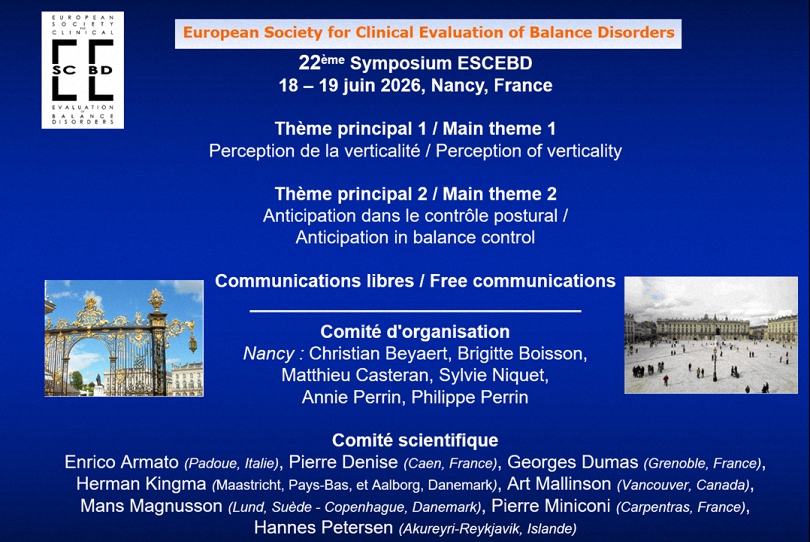
La compréhension des mécanismes qui permettent l’équilibration corporelle par rapport à la verticale est essentielle. Les pertes d’équilibre peuvent être analysées sous l'angle du contrôle moteur afin de mieux comprendre la relation entre, d'une part, les capacités d’équilibration d'un sujet et, d'autre part, le contexte qui place ce sujet dans un environnement susceptible de provoquer une chute (apprentissage de la marche chez le nourrisson, marche sur une surface verglacée, prévention des chutes chez le sujet âgé). Si les perturbations de l'équilibre sont prévisibles, il pourra être mis en jeu des mécanismes d'anticipation pour corriger cette perte potentielle d'équilibre. L’anticipation peut donc être nécessaire au maintien de la verticalisation. Ces anticipations, automatiques et/ou cognitives, prendront en compte la force de gravité associée à la verticalité comme référentiel constant pour organiser les composantes de force du contenu moteur. Les anticipations sont aussi essentielles dans le cadre de la prévention du mal des transports (anticipation par la vision de situations pouvant générer un mal des transports afin de moins subir de conflit sensoriel, …) et de la performance sportive.
Studying the mechanisms that enable the body to orient with respect to vertical is essential as it is important to understand how balance is maintained in situations where this might be a challenge (e.g. an infant learning to walk; walking on an icy surface; fall prevention in the elderly). Balance maintenance is a complex task and requires an ability to utilize gravitational vertical, which is completely reliable reference vector. Keeping balance in the dynamically unstable biped can be analyzed from a motor control perspective. To further our understanding of this process, it may be helpful to analyze motor control strategies that are utilized in this task. Anticipation is often a vital aspect of balance maintenance in certain situations. If balance disturbances are predictable, anticipation strategies could be used to avoid a potential loss of balance. These strategies may be reflexive, cognitive, or both, and again must be referenced to gravitational vertical, to make sure that motor programs that have been preplanned are appropriate. Anticipation is also an extremely important aspect of performance in the elite athlete. Anticipation is also essential in the prevention of motion sickness (i.e. developing strategies to try and minimize the unpleasant symptoms that are often generated by a sensory conflict.
Comité d'organisation Nancy : Christian Beyaert, Brigitte Boisson, Annie Perrin, Philippe Perrin
Comité scientifique Enrico Armato (Padoue, Italie), Pierre Denise (Caen), Georges Dumas (Grenoble), Herman Kingma (Maastricht, Pays-Bas, et Aalborg, Danemark), Art Mallinson (Vancouver, Canada), Mans Magnusson (Lund, Suède, et Copenhague, Danemark), Pierre Miniconi (Carpentras), Hannes Petersen (Akureyri, Reykjavik, Islande)
Brasserie Excelsior 50, Rue Henri Poincaré 54000 NANCY
PRE-PROGRAMME (20/03/2026)
Jeudi 18 juin 2026
Thème principal 1 / Main theme 1 Perception de la verticalité / Perception of verticality
Pierre Denise, Caen, France - Les mécanismes de la perception de la verticalité / The mechanisms of verticality perception - 30 min.
Art Mallinson, Vancouver, Canada - How the « fight or flight » response maintains verticality / Comment la réponse « combat ou fuite » maintient la verticalité - 20 min.
Pathophysiology of verticality disorders / Physiopathologie des troubles de la verticalité.
Enrico Armato, Padoue-Venise, Italie - Moyens d’évaluation de la performance et des troubles de la verticalité / Assessment methods for performance and disorders of upright posture - 30 min.
Herman Kingma, Maastricht, The Netherlands, and Aalborg, Denmark - Perception of the verticlity by the otolith system / Perception de la verticalité par le système otolithique - 45 min.
Salma Jbyeh, Paris, France - Perception de la verticalité chez l'enfant : de la maturation aux situations pathologiques / Perception of verticality in childhood: from maturation to pathological situations - 20 min.
Hannes Petersen, Reykjavik, Iceland - Verticale visuelle subjective chez les marins adaptés aux environnements marins / Subjective visual vertical in sailors adapted to marine environments - 20 min.
Kathrine Jáuregui-Renaud, México - The Subjective Visual Vertical precision but not the accuracy may decrease in old age, according to general health / La précision visuelle subjective verticale, mais pas l'exactitude, peut diminuer avec l'âge, selon l'état de santé général - 15 min.
Loïc Vest, Kinésithérapeute vestibulaire, Paris - Perception de la verticalité dans les commotions cérébrales / Perception of verticality in concussions.
Pierre Denise, Caen, France - Verticalité et régulations végétatives / Verticality and autonomous regulations - 30 min.
Gaëlle Quarck, Caen, France - La verticalité n'est pas statique : influences de l'heure de la journée et du cycle veille-sommeil sur la verticale visuelle subjective et l'équilibre / Verticality is not static: time-of-day and sleep-wake influences on subjective visual vertical and balance.
Pierre Denise, Caen, France - Conséquences de l’impesanteur sur la perception de la verticalité / Effects of weightlessness on the perception of verticality - 15 min.
Philippe Goudard, Montpellier, France - Importance de la représentation de la verticalité dans les pratiques acrobatiques des arts du cirque / The importance of the vertical representation in acrobatic circus arts practices - 20 min.
Sandy Sun, Trapéziste, Montpellier, France - Expérience d’un rapport salvateur et créatif à la verticalité / Experience of a life-saving and creative relationship with verticality - 10 min.
Amir Kheradmand, Baltimore, Maryland, USA - Posture and gait analysis: a new computer vision video method - 20 min.
Amir Kheradmand, Baltimore, Maryland, USA - The Bayesian sensory integration model and its clinical value as a biomarker for vertical perception - 10 min.
Naïma Deggouj, Université Catholique de Louvain, Belgique - Syndrome de décorporation. Cas clinique chez un adulte / Out of body syndrome. Clinical case in an adult - 10 min.
Imen Ben Rejeb, Service d'ORL Pédiatrique, Hôpital d'Enfants, CHRU de Nancy, France - Syndrome de décorporation. Cas clinique chez un enfant / Out of body syndrome. Clinical case in a child - 10 min.
Bernard Cohen, Paris - Pathologies vestibulaires : marche et anticipation.
Philippe Perrin, Nancy, France - Importance du maintien de la verticalité chez les chanteurs d’opéra / The importance of maintaining verticality in opera singers.
Charlotte Van Oost, Nancy, France - Influence du contrôle postural sur la pratique vocale du chanteur lyrique / Influence of postural control on the vocal technique of opera singers.
.../...
Proposition d'un consensus concernant le thème de la verticalité.
Communications libres / free communications
Vendredi 19 juin 2026
Thème principal 2 / Main theme 2 Anticipation dans le contrôle postural / Anticipation in balance control
Mans Magnusson, Lund, Sweden, and Copenhagen, Danemark - Definition and physiological basis of anticipation. Examples and consequences / Définition et bases physiologiques de l’anticipation - 30 min.
Anticipation in balance control to prevent fall / Anticipation dans le contrôle de l'équilibre pour prévenir les chutes.
Kathrine Jáuregui-Renaud, México - Diabetes may distort ankle movement and the influence of age on postural sway / Le diabète peut altérer les mouvements de la cheville et l'influence de l'âge sur les oscillations posturales _ 15 min.
Experimentation through anticipation allows the learning of walking / L’expérimentation par l’anticipation permet l’apprentissage de la marche.
Christian Beyaert, Nancy, France - Développement des anticipations posturales en position assise chez le jeune enfant / Development of postural anticipations in a seated position in young children.
Anticipation in balance control to prevent motion sickness / Anticipation dans le contrôle de l'équilibre pour prévenir le mal des transports.
Matthieu Casteran, Nancy, France - L'intention : un déterminant de la préparation du mouvement / Intention: determinant of movement preparation.
Anticipation pour la performance sportive / Anticipation for sporting performance.
Anticipation combined with attention helps improve balance control / L'anticipation associée à l'attention contribue à améliorer le contrôle de l'équilibre.
.../...
Synthèse
Proposition d'un consensus concernant le thème de l’anticipation.
Proposition d’une synthèse des deux thèmes : L’anticipation participe-t-elle à l’établissement et au maintien de la verticalisation ? / Does anticipation help to establish and maintain verticalisation? La verticalisation nécessite-t-elle une anticipation ? / Does verticalisation require anticipation?
Ateliers (30 mn/atelier - Ateliers successifs)
Posturographie Dynamique connectée à la Réalité Virtuelle - Virtualis / Dynamic Posturography connected to Virtual Reality - Virtualis.
Art Mallinson, Vancouver, Canada - Computerized Dynamic Posturography: How to do it; What it will tell us (what it won't tell us) / Posturographie dynamique informatisée : intérêt dans l’évaluation de l’anticipation.
Georges Dumas, Grenoble, France - Modifications du nystagmus induit par vibrations lors d’inclinaisons de la tête / Changes in vibration-induced nystagmus during head tilting.
Pierre Miniconi, Carpentras - Appréciation de la verticalité par le test de Miniconi / Assessment of verticality using the Miniconi test.
Claude-Yves Pelsy, Bernardswiller, France - Intérêt de la psychonomie dans le domaine neuro-sensoriel et la posture.
Participant-e-s
Dr Enrico Armato - Oto-Rhino-Laryngologie et Phoniatrie, Padoue, Italie, UR 3450 DevAH, Université de Lorraine, France
Dr Imen Ben-Rejeb - ORL, Nancy, France
Dr Matthieu Casteran - UFR STAPS-Faculté des Sciences du Sport, UR DevAH, Université de Lorraine, France
Dr Laurent Coffinet - Service d'ORL Pédiatrique, CHRU de Nancy, UR DevAH, Université de Lorraine, France
Dr Bernard Cohen - ORL, Paris, France
Pr Pierre Denise - Physiologie médicale, CHU de Caen, et INSERM, U1075 COMETE, Université de Caen Normandie, Caen, France
Dr Georges Dumas - Oto-Neurologie, CHU de Grenoble, UR 3450 DevAH, Université de Lorraine, France
Pr Philippe Goudard - Arts du Spectacle, Université de Montpellier, France
Kathrine Jáuregui-Renaud - Senior Researcher, Unidad de Investigación Médica en Otoneurología, Instituto Mexicano del Seguro Social, México
Dr Salma Jbyeh - ORL, Hôpital Robert Debré, AP-HP, Université Paris Cité, Centre Neurosciences Intégratives et Cognition - UMR 8002 CNRS, Paris
Dr Amir Kheradmand - MD, Dpt of Neurology, The Johns Hopkins University School of Medicine, Baltimore, Maryland, USA
Prof. Herman Kingma - Clinical Vestibulology, Maastricht, The Netherlands, and Aalborg University, Denmark
Dr Badreddine Kriem - Directeur de la Faculté des Sciences du Sport, UR 3450 DevAH, Université de Lorraine, France
Dr Neil Longridge - Div. of Otolaryngology, Faculty of Medicine, University of British Columbia, Vancouver, Canada
Prof. Mans Magnusson - Dpt of Ear, Nose and Throat Diseases, Lund, Sweden, and Copenhagen, Danemark
Dr Art Mallinson - Div. of Otolaryngology, Faculty of Medicine, University of British Columbia, Vancouver, Canada
Dr Pierre Miniconi - ORL, Carpentras, France
Dr Nicolas Perrin - Médecine Physique et de Réadaptation, Institut Régional de Réadaptation, Centre de Réadaptation pour Enfants, Flavigny-sur-Moselle, France
Prof. Hannes Petersen - Dpt of Otorhinolaryngology and Dpt of Anatomy, Faculty of Medicine, University of Iceland, Reykjavik, Iceland
Gabriel Poirier - UFR STAPS-Faculté des Sciences du Sport, UR DevAH, Université de Lorraine, France
Pr Gaëlle Quarck - UFR STAPS, COMETE U1075, INSERM, CYCERON, Université de Caen Normandie, Caen, France
Heiko M Rust - MD, Dpt of Neurology, Vestibular Neurology Unit, Imperial College London, UK, and Centre for Vertigo, Dizziness and Imbalance, University of Basel Hospital, Switzerland
Frédérique Serra - Orthoptiste, Vandoeuvre-lès-Nancy, France
Dr Irene Stella - Service de Neurochirurgie Pédiatrique, CHRU de Nancy, Responsable du Centre de Compétence, Maladies Rares Craniosténoses et Malformations Cranio-faciales (CRANIOST), UR 3450 DevAH, Université de Lorraine, France
Sandy Sun - Trapéziste, Formatrice dans les Ecoles Supérieures Professionnelles de Cirque, Montpellier, France
Charlotte Van Oost - Département d’Orthophonie, Faculté de Médecine, Maïeutique et Métiers de la Santé, Université de Lorraine, France
Loïc Vest - Kinésithérapeute, Paris, France
Contact :
Professeur Philippe PERRIN UR 3450 - DevAH Faculté de Médecine Bâtiment C - 1er étage 9, Avenue de la Forêt de Haye 54500 Vandoeuvre-les-Nancy mail : philippe.perrin@univ-lorraine.fr

 Chargement...